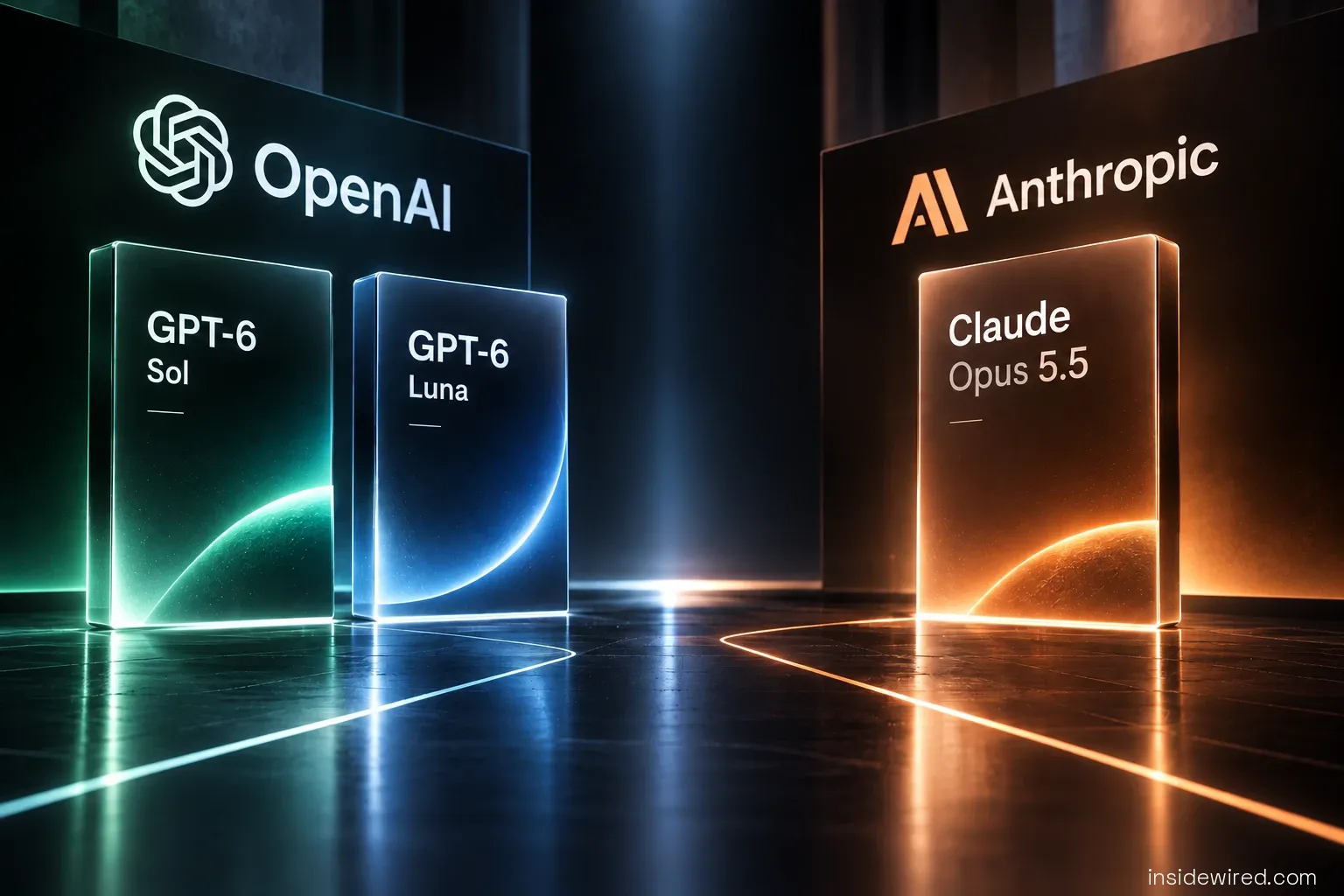
OpenAI and Anthropic have almost simultaneously unveiled three new models that mark a new phase in their rivalry. GPT-6 Sol and Luna significantly lower the cost of accessing the GPT-6 family, while Claude Opus 5.5 brings Anthropic’s high-end performance to a more accessible price point. Beyond benchmark scores, competition is now increasingly centered on the sheer amount of work accomplished for every dollar spent.
The announcements followed one another on September 22nd with approximately a ninety-minute interval. Anthropic first presented Claude Opus 5.5, before OpenAI expanded its GPT-6 lineup with Sol and Luna. While the three models are not aimed at exactly the same use cases, their close launches highlight a common trend: offering more capabilities at a distinctly lower operating cost.
Model Specializations and Focus Areas
OpenAI defines specific roles for its new offerings within the GPT-6 family. GPT-6 Sol is positioned for complex professional work, software development, agents, and tasks involving computer usage. Conversely, GPT-6 Luna prioritizes speed, high volumes, and more targeted operations. For the most demanding tasks, GPT-6 Astra remains the most capable model in the family. OpenAI reports that a portion of this price drop is attributed to advancements made in its caching and inference infrastructure.
Anthropic follows a similar strategy with Claude Opus 5.5, maintaining a high-end presence while improving accessibility. The company emphasizes efficiency in agents working over long periods, citing an example where a migration involving 680,000 lines of code was completed in less than a day by an early user.
Comparative Cost Analysis
The pricing structures reveal a clear push toward economic efficiency for both companies.
For OpenAI's GPT-6 lineup, the difference is notable:
- GPT-6 Sol: $2 per million input tokens and $10 per output token. Official API data adds a rate of $0.20 per million cached tokens.
- GPT-6 Luna: Drops significantly to $0.10 per input token and $0.50 per output token. The cached token cost is just $0.01 per million.
OpenAI frames these rates as a 50% reduction compared to the promotional prices of the GPT-5.6 generation.
Anthropic’s Claude Opus 5.5 is priced at $4 per million input tokens and $20 per output token, marking a slight cost increase from its predecessor, Opus 5 (which was $5/$25). However, Anthropic estimates that true savings reach approximately 40% on typical workloads because Opus 5.5 also utilizes fewer tokens to accomplish certain tasks compared to previous versions.
Performance Claims and Positioning
The competitive nature means performance improvement is tightly linked to cost reduction.
Anthropic introduced Opus 5.5 as capable of reaching the level of Claude Fable 5.1 across most tasks while surpassing it in several agentic evaluations. For instance, Anthropic reported a score of 66.4% for Opus 5.5 on Terminal-Bench 4.0, compared to 55.8% for Fable 5.1 and 52.3% for Opus 5.
Security remains a key pillar in Claude Opus 5.5's positioning. Anthropic stated that the model was evaluated by external organizations, including METR and Frontier Design. The company claims that Opus 5.5 achieved its best results to date in an automated behavioral audit covering nearly 2,000 scenarios, reporting approximately an 85% reduction in attempts to breach confinement limits compared to Opus 5 and Mythos 5.1.
While neither company has yet released a direct comparison between GPT-6 Sol and Claude Opus 5.5 conducted with the same parameters, available results highlight distinct strategies:
- Opus 5.5 maintains an ambitious positioning for complex agentic tasks.
- Sol offers a gross price half that of its competitor at $2/$10 versus $4/$20.
Luna, by contrast, is geared toward high volumes and repetitive tasks (at $0.10 per million input tokens), rather than direct competition with Opus 5.5. This allows OpenAI to offer multiple tiers: Astra for the most challenging problems, Sol for complex recurring tasks, and Luna for cost-and volume-driven operations.
The New Focus on Efficiency
The launches suggest that the market comparison is evolving beyond simple capability scores. With GPT-6 Sol, Luna, and Claude Opus 5.5, both companies now emphasize economic efficiency: token cost, cache utilization, number of steps required, success rate, and total work accomplished. For enterprises deploying large-scale agents, the true measure of performance may therefore rest less on the advertised price of one million tokens and more on the total cost required to correctly complete a task.
Anthropic's positioning is further colored by the context of safety, as Opus 5.5 was the first model published after Dario Amodei called for collectively moderating the pace of progress among advanced systems. Anthropic clarified that this stance seeks a sustainable pace allowing safety work to keep up with growing capabilities.
Ultimately, the competition between OpenAI and Anthropic is transforming the AI race into a battle over performance-to-cost ratio. Future independent tests will be essential to determine if the steep price drops announced by both companies truly translate into lower total costs for large-scale applications and agents.